I am looking for oil paintings and works on paper by Witold Kaczanowski. Bought directly from private owners — no commission, no auction, no gallery. A fair valuation, complete discretion, prompt payment.
Get in touch
"Witold-K — the painter who made colour an absolute language. Every canvas is the pulse of living colour."
I buy directly and discreetly. I am looking above all for large-format canvases from the 1960s to the 1980s, though every work by Witold-K matters to me.
Wit Leszek Kaczanowski — known simply as Witold-K — was born on 15 May 1932 in Warsaw. He studied in the graphics department of the Warsaw Academy of Fine Arts, where his teachers included Eugeniusz Arct, Henryk Tomaszewski and Wojciech Fangor.
In 1964 he left for Paris on a scholarship from the Ministry of Culture and Art, working first on rue Lamandé and later on the Quai Montebello. It was in Paris that he met Pablo Picasso, who painted his portrait, as well as Jacques Prévert and Françoise Sagan. Returning to Poland proved impossible: the authorities had discovered he had smuggled out a text by Stanisław Mackiewicz.
In 1968 he moved to New York, and in the summer of 1969 to Los Angeles, where he opened his own studio-gallery on Wilshire Boulevard. He worked afterwards in Santa Fe, New Mexico, and in Houston, before settling permanently in Denver, Colorado, from 1980. In 2007 he became the first Pole to be given a retrospective at Sotheby’s in Amsterdam.
His painting is above all about colour: saturated magentas and carmines, fields of deep black out of which hot colour erupts, forms at once cosmic and organic. A Witold-K canvas is built in layers — glazes laid over opaque grounds, surfaces built up and scraped back, a texture that catches the light.
Late in life he returned to Poland, living in Warsaw and in Konstancin-Jeziorna. He died on 12 March 2025 and was buried on 14 April in the Powązki Cemetery in Warsaw, in his mother’s grave. He left several hundred canvases, works on paper and prints scattered across Europe and the United States — and those are what I am looking for.
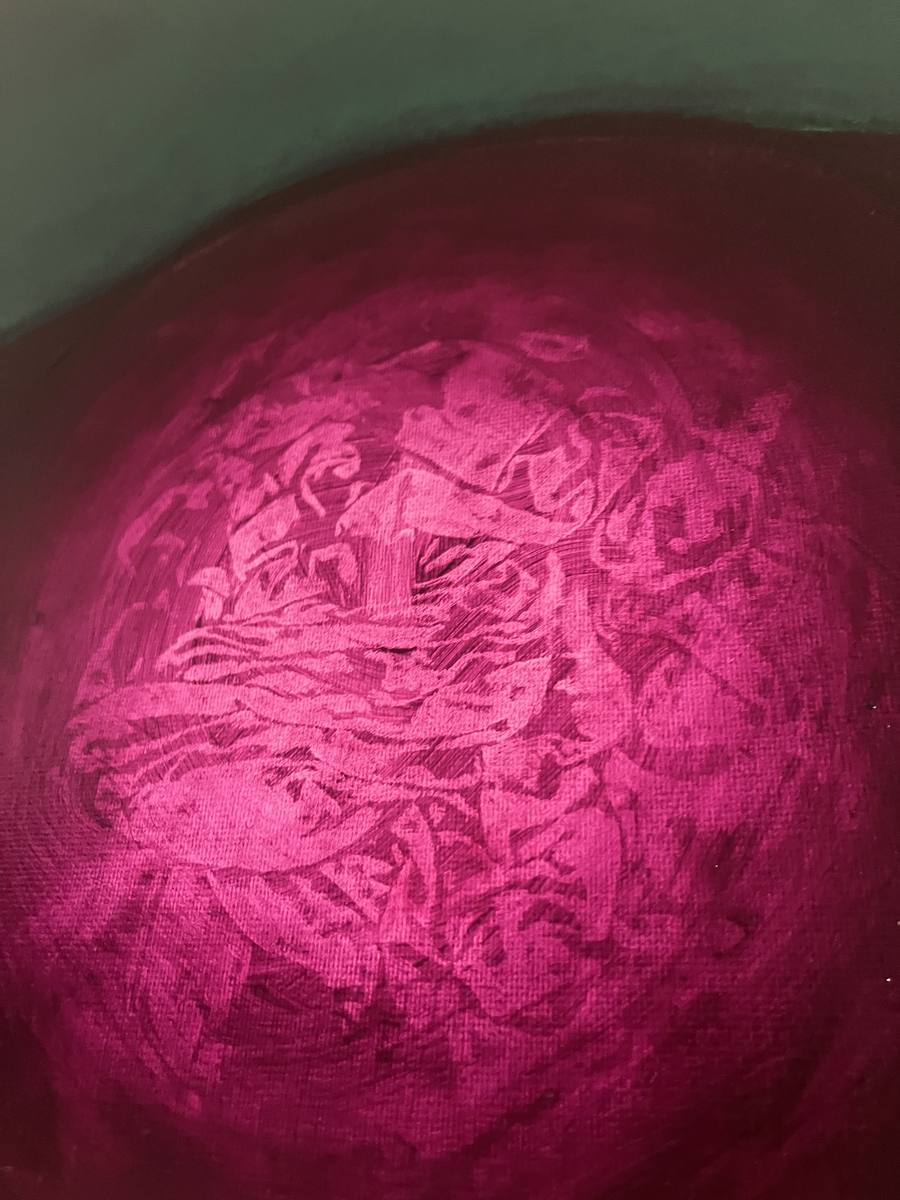
I buy directly and discreetly. I am looking above all for large-format canvases from the 1960s to the 1980s, though every work by Witold-K matters to me.
Large canvases and small formats alike — the characteristic magenta, the carmines, deep black with colour breaking through.
Drawings, watercolours, gouaches, pastels — on paper Witold-K made a separate and more intimate world.
Lithographs and screenprints — his painterly language carried into original print techniques.
I consider works needing restoration, works without a frame, works with uncertain attribution or incomplete documentation.
I buy without intermediaries — the margin stays with the owner.
Based on market data. No lowballing, no pressure.
Your details and any information about the work are kept private. Enquiries are confidential.
Witold Kaczanowski — known as Witold-K — appears regularly on the Polish auction market. In the archive of DESA Unicum prices achieved for his paintings run from about 7,500 to 32,000 zł; the highest result there was for the large canvas Green Hole (1985, acrylic, 96.5 × 111.5 cm) — 32,000 zł. Agra-Art prices the works it has available in the same band: from 7,500 zł for an ink drawing to 34,000 zł for a canvas of 100 × 130 cm.
These figures come from the two houses’ public archives — auction results in the case of DESA Unicum, asking prices in the case of Agra-Art. They are not a valuation of your work: format, period, condition and provenance all decide the price.
Price is ordered above all by format: large acrylics on canvas sit at the top, smaller oils from the 1960s and 70s fall around 11,000–22,000 zł, and works on paper — drawings, watercolours, gouaches — start near 7,500 zł. The late Samotność (Solitude) cycle (after 2005) reaches prices comparable to the early oils — which sets Witold-K apart from many painters of his generation, where almost only the early period counts.
Buying directly from a private owner avoids auction commission — usually 15–25% of the hammer price — and gallery costs. For the seller that means more in hand; for the buyer, direct contact with the work’s history and provenance.
Write to me. A photograph and a few lines are enough — I reply within 24 hours.